Guides
Part of Twelve kinds of home energy contractor, and who does what: the 2027 view
4 things about home energy contractors worth your time
Building a contractor relationship that lasts: how to set up service arrangements and records so future work is easy, continuity of documentation.
Equipment lasts longer than most contractor relationships. Companies close, technicians move, and the person who knows why your system was configured a particular way stops answering the phone. The defense is documentation you own rather than a relationship you hope persists, plus a service arrangement structured to survive a change of provider.
What to take away
- Keep records in your own hands, not in a contractor's system.
- Service agreements should be portable, not tied to one firm's software.
- Ask what training a company invests in, because the technology moves.
- Plan for the firm closing, because a proportion of them will.
The file that outlives everybody
Assemble one folder per major system and keep it yourself:
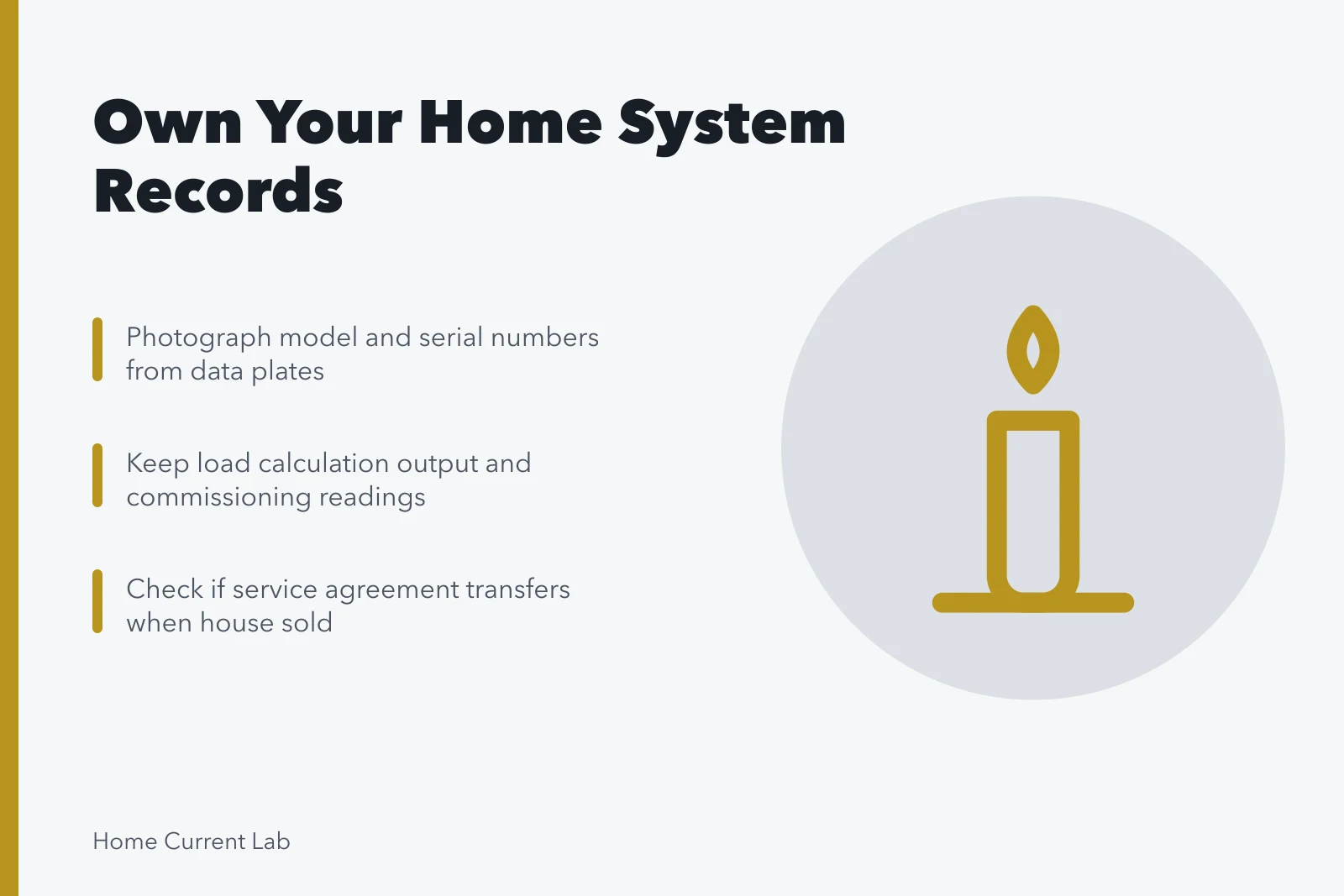
- Model and serial numbers, photographed from the data plate.
- The load calculation output and any modeling files.
- Commissioning readings, including control settings.
- Permit numbers and inspection sign-offs.
- Warranty registration confirmations.
- Every service invoice, including courtesy visits.
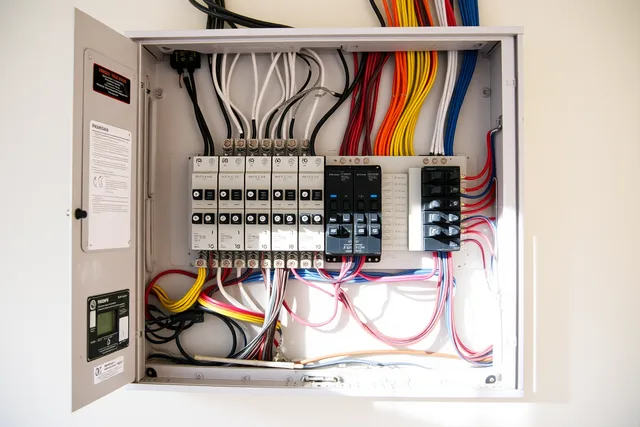
- A one-line diagram of the electrical distribution, if you have one.
Any competent technician can pick up a system from that file. Without it, a new company starts by re-deriving what the last one already knew, and charges you for the time.
Keep it somewhere that survives a phone upgrade and a house move. A paper copy near the equipment plus a scanned set in your own storage covers both the technician standing in the basement and the claim you file three years later.
Service agreements, read properly
Service agreements smooth cost and usually satisfy the warranty documentation requirement, which is their main value. Read three things before signing:
- Whether the agreement transfers if the house is sold.
- Whether cancelation is possible mid-term and on what terms.
- Whether the visit record is provided to you or only held internally.
That third point matters most. An agreement whose records live only in the provider's system is worth much less when you change provider.
Choose for the direction of travel
Equipment categories keep arriving, and a contractor who stopped learning a decade ago will steer you towards what they already know. The Department of Energy's work on thermal energy storage is one example of a building technology area that has moved from research towards deployment, and there will be others.
The wider point holds at grid scale too. EIA's account of how new technology can improve electric power system efficiency and reliability describes the same dynamic on the network side of the meter. What a homeowner should take from it is a question rather than a technology preference: what training did your crew do this year, and on what?
When the firm closes
| Risk | Mitigation |
|---|---|
| Company ceases trading | Warranty claims go to the manufacturer; keep registrations |
| Technician leaves | Your file lets a replacement start informed |
| Software account closes | Never store the only copy of records in a vendor app |
| Program ends | Keep program documentation for the equipment life |
| Manufacturer exits the market | Parts availability becomes the constraint; ask about it at purchase |
Most of these are solved by the same habit: own your own records. For the same principle applied to the physical installation, see our piece on designing an install you can extend later; the roles you may need over time are mapped in twelve kinds of contractor.