Costs
Massachusetts heat pump rebates in 2025: what Mass Save actually pays
Mass Save heat pump rebates in 2025: the tier amounts, eligibility rules, required paperwork, and how the 25C federal credit stacks on the net cost.
What to take away
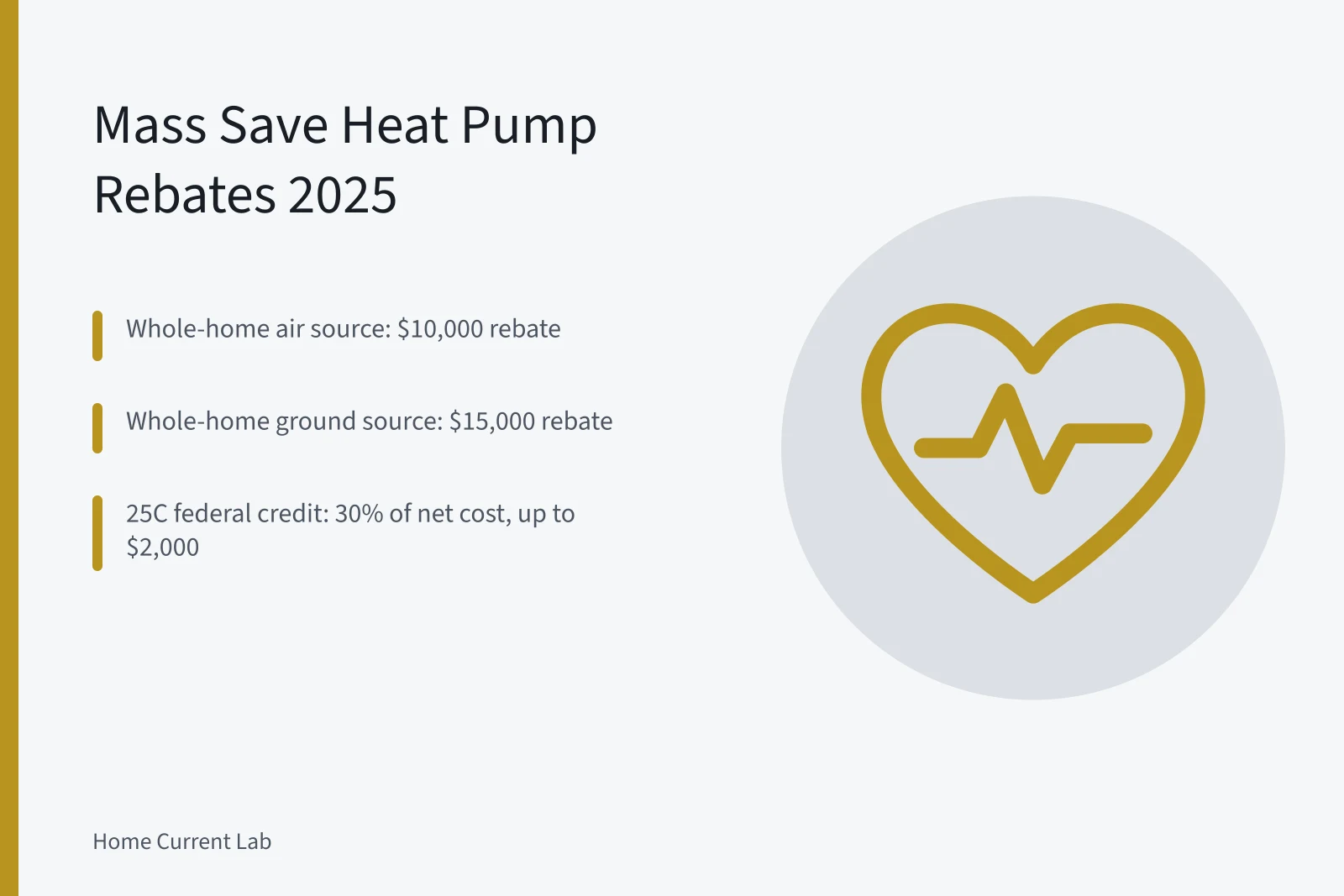
- Mass Save pays $10,000 for a whole-home air-source heat pump and $15,000 for a whole-home ground-source system in 2025.
- Partial-home installs earn far less, roughly $1,250 per ton of heating capacity, so the whole-home route pays better.
- The federal 25C credit returns 30% of your net cost, capped at $2,000 a year for heat pumps.
- Claims require a Mass Save participating installer, listed equipment, and an itemized invoice with an AHRI certificate.
Whole-home versus partial-home rebate tiers
Mass Save splits residential heat pump rebates into two tiers. The whole-home tier pays the most because the heat pump carries the full heating load through the winter.
Typical 2025 rebate
- Whole-home air source
- $10,000
- Whole-home ground source
- $15,000
- Partial-home air source
- About $1,250 per ton
- Heat pump water heater
- $750
What it requires
- Whole-home air source
- Heat pump as primary heat
- Whole-home ground source
- Geothermal loop, full load
- Partial-home air source
- Serves part of the house
- Heat pump water heater
- ENERGY STAR listed unit
The Massachusetts Department of Energy Resources manages state energy programs and points to the pathways that serve income-eligible households. That branch can cover most or all of an installed cost instead of paying a flat rebate.
Eligibility conditions behind the numbers
- The home sits in a sponsoring utility territory, such as Eversource, National Grid, Unitil, Liberty or the Cape Light Compact.
- A Mass Save participating heat pump installer performs the work and pulls the permit.
- The equipment appears on the Mass Save qualified products list, with an AHRI certificate as proof.
- Whole-home claims show the heat pump as the primary heating source, backed by a room-by-room load calculation.
- The rebate cannot exceed the invoice total.
Cold-climate models matter here, because Massachusetts winters push equipment past the range of older units. Modern cold-climate heat pumps hold capacity at low outdoor temperatures, which is why the qualified products list separates them from standard models.
Mass Save HEAT Loan and financing
The Mass Save HEAT Loan offers 0% interest financing up to $50,000 over seven years. It covers qualifying improvements, including heat pumps and the insulation that makes them perform. The loan is separate from the rebate, so a homeowner can use both on one project. A completed Mass Save Home Energy Assessment is required first.
Documentation and application steps
- Collect a written proposal with exact model numbers from a participating installer.
- Check every model against the Mass Save qualified products list and save the AHRI certificate.
- Pay the invoice in full after commissioning and keep the itemized receipt.
- Submit the rebate application inside the program window, commonly 90 days from installation.
- Claim the 25C credit on the return for the year the system was placed in service.
How the 25C credit stacks with the rebate
The federal credit covers 30% of the cost of a qualifying heat pump, capped at $2,000 per year. Heat pump water heaters share that same $2,000 ceiling. A separate $1,200 cap covers other measures, including a $600 limit for an electrical panel upgrade.
IRS rules require you to subtract the Mass Save rebate before you compute the credit. A $10,000 rebate shrinks the credit base to the balance you actually paid.
The credit reduces tax owed dollar for dollar. It is not a discount at the register, and any amount above your tax liability is lost.
Example: net cost of a $16,000 whole-home install
A contractor quotes $16,000 for a cold-climate whole-home system. Mass Save approves a $10,000 rebate, leaving $6,000 out of pocket. The 25C credit is 30% of that $6,000, or $1,800, which sits under the $2,000 cap. The final net cost lands near $4,200.
Panel capacity and the induction range next step
A heat pump adds load to the service panel, and so does an induction range added later. Load calculations and minimum service sizing follow the rules in NFPA 70.
Many Massachusetts homes still run on 100-amp service, which can force an upgrade before both appliances fit. That panel work is the piece the federal credit actually touches.
If the range is part of your plan, Massachusetts induction range rebates come from a different program, and the panel upgrade is what carries the federal money.