Costs
Smart meter opt-out and privacy: what US and Canadian homeowners can actually choose
Smart meter opt-out and privacy rules for US and Canadian homeowners: opt-out fees, data access requests, consent settings, and utility data sharing limits.
What to take away
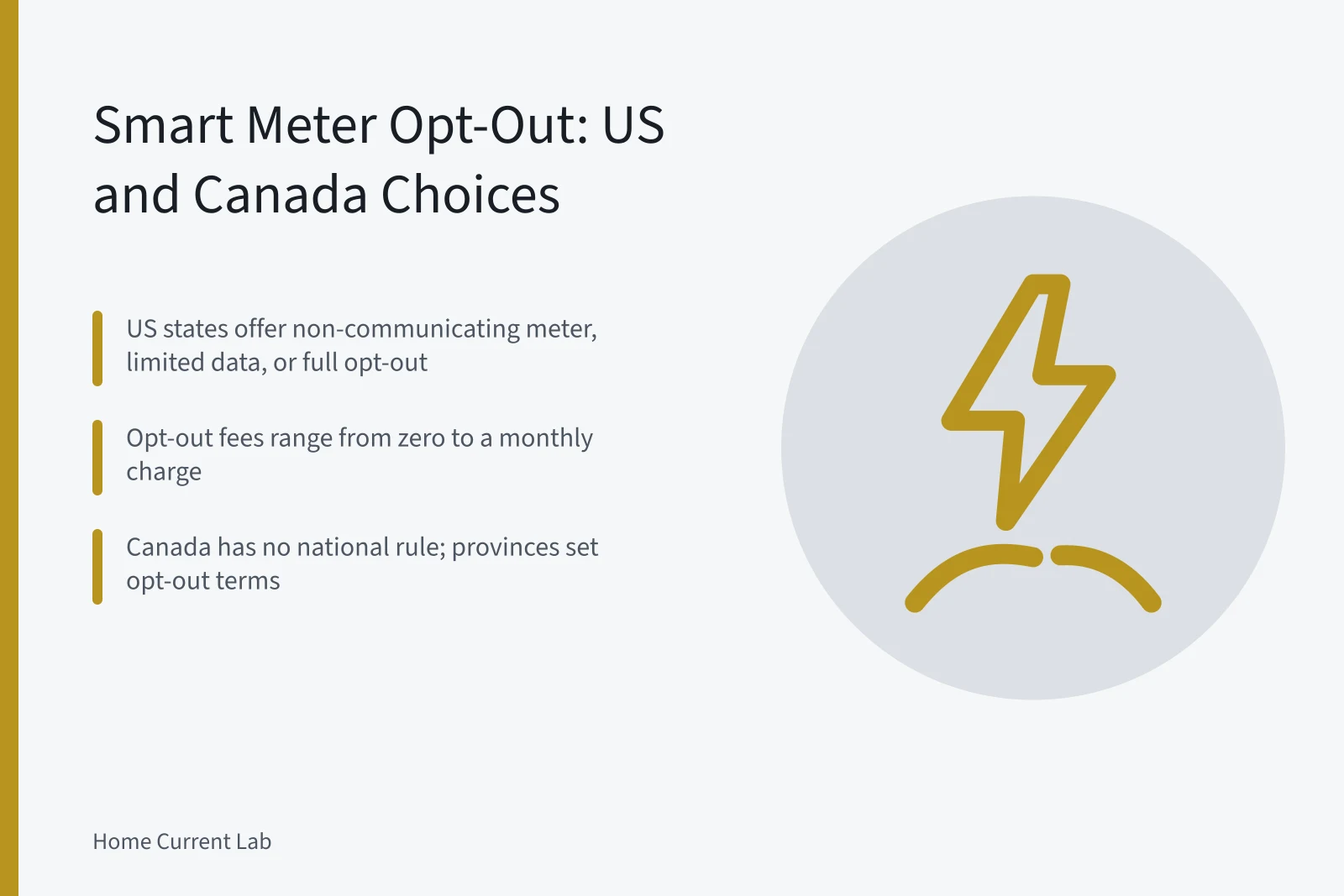
- In most US states, you can choose a non-communicating meter, a limited data mode, or a full opt-out with a fee.
- Canadian rules vary by province; some utilities allow opt-out, while others only offer privacy settings inside the portal.
- You can file a utility data access request to see what is shared and with whom.
- Opt-out fees range from zero to a monthly charge, and they are usually listed in the utility tariff.
- State regulators, not the utility alone, set the allowed opt-out terms.
How smart meter opt-out works in the United States
Smart meters, also called AMI meters, record electricity use at short intervals. Many utilities let you opt out of a communicating meter, but the options differ. Common choices include a non-communicating digital meter, a drive-by reading meter, or a daily manual read.
Some states require a fee for the opt-out because the utility loses remote reading. You can find the terms in your utility's filed tariff.
Canadian opt-out and consent rules
Canada has no single national opt-out rule. Provinces such as Ontario, British Columbia, and Quebec have different approaches. Some utilities let customers refuse a smart meter, often with a fee or a legacy meter.
Others do not allow a full opt-out, but they provide privacy controls in the online portal. Provincial regulators such as the Ontario Energy Board and the British Columbia Utilities Commission oversee utility terms.
Data access requests and utility portals
You can ask your utility for a copy of your energy data. This is often called a utility data access request. The request may cover interval data, billing history, and sharing with third parties.
If you want the full picture of how utility portals and connected appliances share energy data, read our guide to home electrification data privacy. That page explains how apps and devices add to the data trail.
Fees and opt-out costs
Opt-out fees are not standardized. Some utilities charge a one-time setup fee plus a monthly fee. Others charge only a monthly fee. A few states allow opt-out at no charge. The fee is usually approved by the state public utility commission. The table below shows typical structures, not exact prices.
Typical fee pattern
- Non-communicating meter
- One-time setup plus monthly
- Limited data mode
- No fee, less frequent reads
- Full opt-out
- Monthly fee
- Portal privacy settings
- No fee
What you keep
- Non-communicating meter
- No radio transmission
- Limited data mode
- Basic privacy
- Full opt-out
- No remote reading
- Portal privacy settings
- Data sharing limits
Even with an opt-out, some data may still be collected for billing and grid operations. You may still need to allow access for safety or outage repair. Your utility privacy policy should list the legal reasons for sharing.
Example: filing a data access request
Filing a data access request
- Find the privacy or data request page on your utility website.
- Submit a written request for your interval data and sharing history.
- Ask for the names of third parties that received your data.
- Request that future sharing be limited if your state allows it.
- Keep a copy of the request and the utility reply.
A written request creates a record. If the utility refuses, you can file a complaint with your state public utility commission. In Canada, contact the provincial regulator or the privacy commissioner.
Privacy policy language to check
- Does the policy list specific third parties or only categories?
- Does it say how long data is kept?
- Does it explain how to withdraw consent?
- Does it mention aggregated data that cannot be linked to you?
For a deeper look at what your meter records and what utilities can infer from the load shape, see smart meter data privacy. That page covers sharing settings that limit the data trail.
What utilities can do with your data
Utilities can use interval data for billing, outage detection, and load forecasting. They can also infer appliance use from the load shape. For example, a heat pump draws power in recognizable cycles, as described by the Wikipedia article on heat pumps. That inference can support electrification programs, but it can also reveal when you are home.
If you add large electric loads, a load calculation under NFPA 70 can show whether your panel needs an upgrade. That process is separate from meter opt-out, but it affects your electrification plan.
State energy offices, such as the Massachusetts Department of Energy Resources, often list rebate programs. Some programs may require you to share energy data as a condition of a rebate.