Costs
Smart meter data and electrification privacy: what your utility can see
What your smart meter records, what utilities can infer from the load shape, and the sharing and opt-out settings that limit the data trail.
What to take away
- A smart meter records usage in short intervals, often 15 minutes or an hour, and files each reading under your account and service address.
- Your utility sees a whole-house load shape, not a room-by-room view, and can infer heating and charging habits from it.
- Data leaves your account in three directionsutility programs, Green Button transfers, and the apps behind thermostats, chargers and heat pumps.
- Some states allow a non-communicating meter for a monthly fee, and device or sharing permissions can be revoked at any time.
- Retention rules differ, so ask how long interval history is kept and who has received it.
The trail starts at the meter
Most U.S. electric meters are advanced meters now, often called AMI for advanced metering infrastructure. They report usage without anyone reading the dial.
Interval length depends on the meter and the utility's systems. Residential intervals are commonly 15 minutes or one hour, and some systems record at five minutes.
Readings travel over radio mesh, cellular or power line carrier links to the utility's head-end system. There they land in a meter data management platform keyed to your account.
That platform feeds billing, outage detection and load forecasting. It is also the file regulators, researchers and third-party vendors request.
A few states require an alternative for customers who object. Maine, Vermont and California have opt-out processes that usually carry a fee.
What a load shape can tell your utility
Interval data is coarse, but patterns repeat. A heat pump compressor cycling through a cold morning reads differently from a resistance heater or a gas furnace blower.
Researchers have used nonintrusive load monitoring since the 1980s to split a whole-house signal into appliance-level guesses. Those guesses are probabilistic, not a live feed from inside your home.
Cold weather sharpens the signal, because heat pump capacity and efficiency shift with outdoor temperature. Wikipedia's heat pump overview explains how that performance curve works.
Utilities also pass aggregated data to regulators and research groups, outside the consent screens in your account.
Panel upgrades leave a paper trail
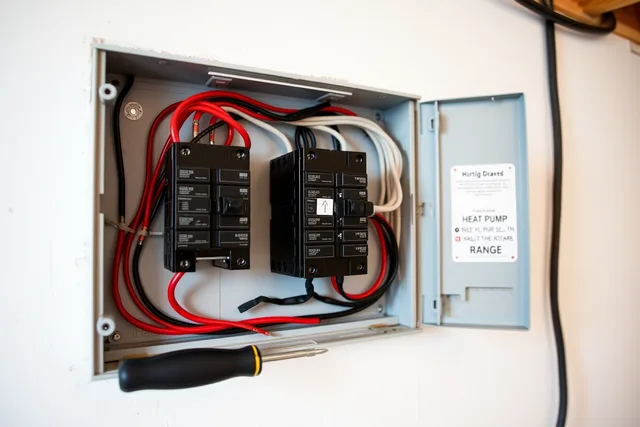
Electrification work often needs more service capacity. An electrician runs a load calculation, and the utility may require a service upgrade before approving the job.
That process creates records: permit applications, inspection results and a new service size on file. Electrical panel capacity and load considerations explain why the number matters. Permit records are often public.
Device telemetry is finer than the meter
Connected appliances create a second data stream. A smart thermostat logs setpoints, runtime and occupancy estimates every few minutes and sends them to its manufacturer.
Utility bring-your-own-device programs, including demand response and managed EV charging, pay customers to let the utility adjust a setpoint or a charging window, which keeps a live data link open.
Heat pump water heaters appear in that telemetry too. ENERGY STAR's heat pump water heater page describes the compressor cycle behind these units.
Example: one winter week in an electrified house
Take a house in Maine with a cold-climate heat pump, an induction range and an EV charged overnight. The meter sees morning and evening heating peaks, a short cooking spike and a steady overnight block.
During a demand response event, the utility's partner lowers the thermostat setpoint by a couple of degrees and shifts charging to after midnight. The household sees both actions in its own app.
Nothing in that record names who is home or which room is in use. The overnight block still reveals a regular charging habit.
How to cut back what the utility and vendors hold
Electrification projects tend to accumulate consent and account errors, so review those before you start revoking access.
How to cut back
- Pull your utility's privacy notice and meter data policy. Ask which vendors receive interval data and under what agreement.
- Request the meter opt-out in writing if your state offers one. Ask how the fee and manual reads appear on the bill.
- Check Green Button authorizations in your utility account. Connect My Data transfers can be revoked, though downloaded files stay with you.
- Unenroll from demand response or managed charging programs you no longer want, and ask the utility to delete the device identifiers on your account.
- Delete unused thermostat, charger and heat pump app accounts, and revoke utility access tokens inside each app.
How to cut back
| Data stream | Who holds it | How to limit it |
|---|---|---|
| Interval meter reads | Utility and its metering vendors | Non-communicating meter where the state allows |
| Green Button transfers | Utility and the third party you approved | Revoke the authorization in your account |
| Thermostat and charger logs | Device maker, utility if enrolled | Unenroll and delete the device account |
A checklist before you revoke anything
- Save 12 months of your interval data as a CSV from the utility portal.
- Write down every program you joined and the date you joined it.
- List the account numbers for each connected device and each linked app.
- Keep the confirmation email or reference number for every opt-out request.