
Guides
Part of Electrification projects planning: a phase-by-phase guide
Planning electrification projects with tomorrow's upgrades in mind
Electrification projects planning: cheap provisions made during an electrification project that make later additions simple, spare conduit, panel spaces.
What to take away
- The cheap provisions are fiveempty conduit to the garage, a capped line-set route, spare breaker spaces, pull strings, and a written capacity record.
- Sizes and endpoints matter more than intent. A note saying conduit to the garage is not a specification.
- Ask for four to six spare full-size breaker spaces, confirmed against a load calculation.
- Do not pre-buy hardware. Buy the route, the space and the paperwork.
- Typical added cost is a low-hundreds line item per run. A later retrofit costs demolition and a second permit.
Five provisions to specify in writing
The list is short: an empty conduit to the garage, a capped line-set route for a future outdoor unit, spare breaker spaces, pull strings, and a capacity record.
Provisions to Specify as Line Items
- Spare conduit runs to garage, attic, exterior
- Panel spaces held open, in writing
- Stub-out at future equipment location
- Blocking or pad for future equipment
- Documented load calculation headroom
Price each item as its own line on the quote. Electrical and mechanical work quote separately, because the trades are different.
Provisions should be cheap and passive. Anything that assumes a specific future product tends to be wrong within a few years.
Five provisions to specify
| Provision | Write this into the quote | Typical added cost, order of magnitude |
|---|---|---|
| Conduit to garage or driveway | 1 inch EMT or Schedule 40 PVC, panel to garage wall, capped and labeled, pull string in place | Low hundreds per run |
| Line-set route for a future outdoor unit | Capped sleeve sized for the line set and condensate, pad space marked, clearances kept | Low hundreds |
| Panel headroom | Four to six spare full-size spaces, confirmed by load calculation | Usually a panel choice |
| Heat pump water heater circuit | Conduit and capped conductors for a 30 A, 240 V circuit at the closet | Mid hundreds |
| Hand-over package | Load calculation, panel one-line diagram, photos of every run, delivered as files | No extra charge if asked at contract |
Conduit sizes, endpoints and cost order
Size is where quotes go vague. Most single 240 V circuits fit inside 3/4 inch EMT. Stepping up to 1 inch costs little per foot and accepts a second circuit or heavier conductors later.
Every run needs a stated endpoint. Panel to garage wall is weak. Panel to the garage wall, 18 inches left of the service door, capped and labeled: that a crew can price.
Empty conduit is crew time and pipe, so it prices as a small line item. The breakdown of where electrification money goes shows how much of a typical budget sits in labor and access rather than hardware.
Labels are the cheap part. Two of them save a future contractor an hour of tracing.
Spare spaces and service capacity
Panels fill up quietly, so headroom is the provision most often lost. Ask for four to six spare full-size spaces and have the electrician confirm the count in writing after the cover goes back on.
Label every empty run at both ends. A future electrician should find a capped conduit in ten seconds, and an unlabeled one may never be found. Photograph the panel with the cover off before it closes.
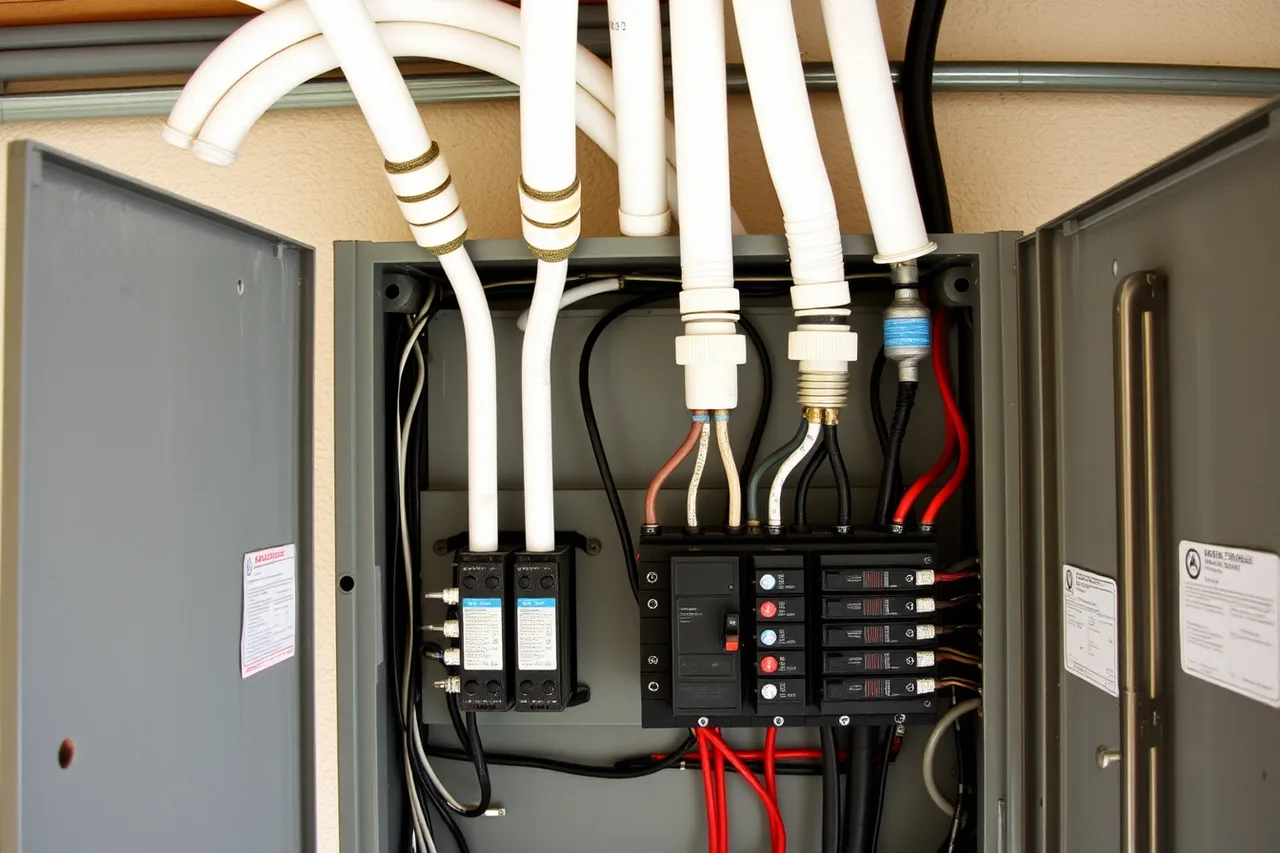
NFPA 70, the National Electrical Code, sets the load calculation that decides how much a service can carry. The article on electrical panels explains bus rating, and why spare spaces and spare amperage differ.
Oversizing the service on speculation is a real cost with no guaranteed use. If you cannot decide whether the panel or the equipment comes first, ranking upgrades by urgency and payback gives you a defensible order.
Example: a capped route for a heat pump water heater
A garage closet holds a gas water heater. The provision now is a 30 A, 240 V circuit stubbed into the closet in 3/4 inch EMT, capped, with a pull string and a condensate path.
ENERGY STAR's page on heat pump water heaters lists efficiency and savings estimates for the units that circuit would later serve.
The sequence, with typical durations
The sequence, with durations
- Plan, one to two weeks before quotes. List the finished-house loads by room.
- Rough-in, on the same visit as the main work. Two or three empty runs take about half a day.
- Panel day, one working day. Get the spare-space count in writing before the cover closes.
- Hand-over, within five business days. Collect files and photographs, not a verbal walkthrough.
- Revisit, every 12 to 24 months. Compare the plan with current equipment before buying.
The phase-by-phase guide to electrification projects shows where these steps sit in a full project, which matters when rough-in shares a day with HVAC work.
Checks before you sign and at hand-over
- Conduit trade size, material and both endpoints written on the quote.
- Pull string in every empty run, ends taped and labeled.
- Spare breaker space count stated as a number, not as some room.
- Load calculation and panel one-line diagram delivered as files.
- Capped line-set sleeve, pad space and clearances confirmed by the mechanical contractor.
Hand-over is the step most homeowners skip. Files settle most arguments with the next contractor.