Reviews
A guide to judging what a home energy monitor can actually tell you
Whole-home, circuit-level and plug-level monitors compared, with what each measures and where device-level disaggregation claims stop being reliable.
A home energy monitor measures electricity crossing one point, at whatever resolution its hardware supports. Everything else on the box, especially the promise to name which appliance is running, is inference layered on that measurement.
What to take away
- Whole-home, circuit-level and plug-level monitors measure different points, and only the last one names an appliance with certainty.
- Disaggregation is a guess built from current waveforms, and variable-speed equipment defeats it.
- Your utility already meters the same point, often at interval resolution, and that data is billing-grade.
- Panel-mounted units go in with the cover off and the service conductors live, so the work belongs to a licensed electrician.
- Ask where the history is stored and whether you can export it before you pay, not after.
The three levels of monitoring
Where it measures
- Whole-home
- Main conductors at the panel
- Circuit-level
- One branch circuit
- Plug-level
- A single outlet
Best at
- Whole-home
- Totals, load shape, peaks
- Circuit-level
- Attributing load to that circuit
- Plug-level
- One appliance, precisely
Weak at
- Whole-home
- Saying what caused a change
- Circuit-level
- Splitting a shared circuit
- Plug-level
- Anything hard-wired
Most households want attribution, buy a whole-home unit, then find attribution is what it does least reliably. If you want to know what the heat pump drew last January, the honest answer is a current transformer on that circuit, not an algorithm reading a waveform.
Three levels of monitoring
Whole-home
- Where
- Main conductors
- Best at
- Totals, peaks
- Weak at
- Saying what caused
Circuit-level
- Where
- One branch circuit
- Best at
- Attributing circuit load
- Weak at
- Splitting shared circuit
Plug-level
- Where
- Single outlet
- Best at
- One appliance precisely
- Weak at
- Anything hard-wired
Why disaggregation deserves skepticism
Whole-home monitors look for characteristic signatures in the current waveform. That works for large loads with sharp on and off transitions. It works poorly for variable-speed compressors, small standby loads, and anything running at the same time as something else.
Homes are getting harder to read this way, not easier, because more equipment now runs at variable speed. Treat a disaggregated breakdown as a hypothesis, check it against a circuit you can switch yourself, and never build a purchase on it alone.
What your utility already has
Your utility meters the same point the monitor watches. Advanced metering is widespread, and the EIA's answer on how many smart meters are installed in the United States and who has them sets out the scale of that deployment and which customer classes have them.
Utility data is free, already collected, and billing-grade. A monitor buys resolution and immediacy, not basic information.
Interval data does reveal things a monthly bill cannot. The EIA's finding that metered demand in the New York system falls midday because of small-scale solar is behind-the-meter behavior visible only at that resolution.
Installation is not a shopping decision
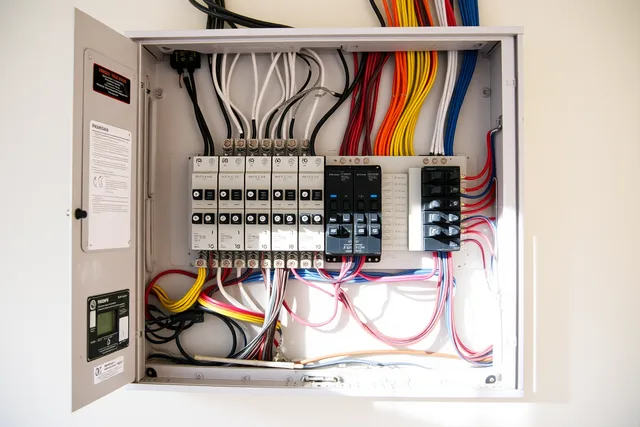
Whole-home and circuit-level monitors mount inside the electrical panel, with current transformers clamped around live conductors. The cover comes off and the service conductors stay energized even with the main breaker open.
So this is licensed electrical work under the Canadian Electrical Code or the NEC as your local authority has adopted it. Plug-level monitors are the exception and need nothing but an outlet.
Where the data goes
Ask before buying: is history stored on the device, in a vendor cloud, or both? Does the unit still record if the vendor's service stops? Can you export the raw record, and in what format? A monitor whose history is locked in an app you cannot export from is a subscription rather than an instrument.
For where monitoring sits in a wider project, see the electrification starting guide. For how it feeds a budget, read our breakdown of where the money goes.
What a monitor is not
It is not a billing instrument, and it will not lower a bill on its own. It is not a substitute for a load calculation when you size a service upgrade; that math uses connected load and demand, not last year's shape.
And it is not a safety device, since it reports current, not the condition of the wiring carrying it.
If you want a fault found, that is an electrician's inspection.
Common questions
Will a monitor lower my bill?
Only if it changes what you do or catches a fault. The device itself saves nothing. The saving, if any, comes from the decision the data prompts.
Is disaggregation accurate?
It varies. Good for large loads with sharp transitions, poor for variable-speed equipment and overlapping small loads. Verify against a circuit you control before trusting a breakdown.
Do I need one if my utility gives me interval data?
Often not. Check what your utility already publishes, and at what interval. A monitor adds immediacy and per-circuit detail, not the totals you may already have.
Can I install one myself?
Panel-mounted units, no. That is licensed electrical work under your local code and authority. Plug-level units need only an outlet, so those are a homeowner task.