Costs
Part of A guide to judging what a home energy monitor can actually tell you
Monitoring costs when the meter is not yours alone
In a shared building the meter covers only part of your use. Here is what monitoring costs, and which approvals stand between you and the data.
In a detached house, monitoring is a decision. In a shared building the monitoring costs are a negotiation, because what you want to measure usually sits on a meter that is not yours alone. Central heating plant, corridor lighting, elevators, pumps and shared hot water sit on building accounts.
What to take away
- A unit meter reads your panel only, never the central plant, elevators or corridor lighting.
- Building-level monitoring is priced as a capital project, not as a device purchase.
- Access, consent and out-of-hours electrical labor usually outweigh the hardware line.
- Plug-in monitors need no building consentthe Sense Home Energy Monitor sells for about $299, the Emporia Vue 3 for about $170.
- Permanent submeters run $300 to $900 per measurement point, the band the Accuenergy AcuRev 1310, Leviton VerifEye and Schneider PowerLogic PM5560 sit in before labor.
- Boards approve a proposal that names the decision the data will inform, and the person who reads it.
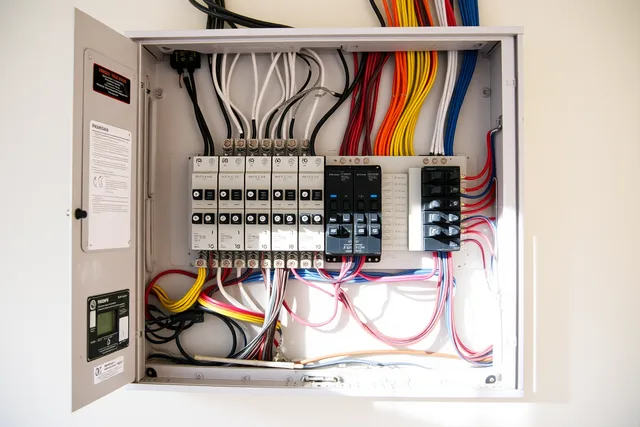
- Anything on a common panel needs the owner's or board's written consent before an electrician opens it.
What your unit meter can and cannot see
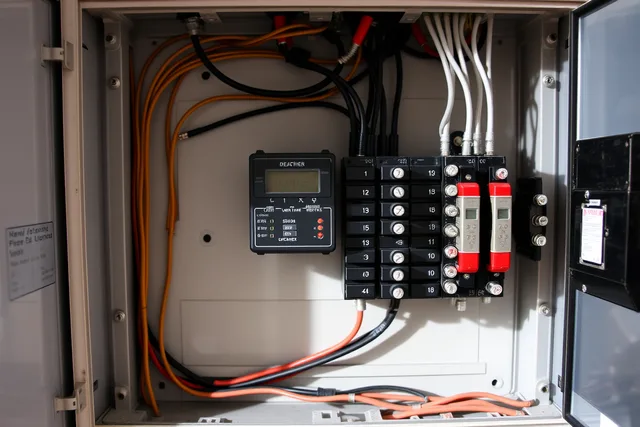
An apartment panel with its own circuits behaves like a house panel, so a monitor there reads those circuits and nothing else. Sense, Emporia and Smappee units clamp around the main legs and the branch wires inside that panel. Shared hot water, central heating and cooling, ventilation and corridor loads are served from a common supply.
That is often most of the energy. Improving your own circuits will not move the building bill you pay through service charges. A plug-in meter such as a Kill A Watt, about $30, or a smart plug such as the TP-Link Kasa EP25, about $25 for a two-pack, measures one appliance and needs nobody's permission.
Why the building-level picture matters
Large residential buildings behave more like commercial property than houses, and commercial end-use patterns are heavily climate-driven.
EIA found that heating commercial buildings is most energy intensive in cold climates, and that cooling them is around six times more energy intensive in hot climates than in cold ones. A unit meter cannot show that variation.
If the question is about the building, the measurement has to be at the building.
What building-level monitoring costs
The figures below are typical US ranges, not quotes, for a 40-unit low-rise with two house panels. Replace them with local prices.
Illustrative monitoring cost lines
- Hardware$1,200–$3,500
- Licensed labor$2,000–$6,000
- Access and consent$500–$2,500
- Network provision$300–$1,500
- Data handling$600–$2,400/yr
- Restoration$400–$1,500
| Cost line | Typical illustrative amount | What it covers |
|---|---|---|
| Hardware | $1,200 to $3,500 | Current transformers and data loggers at each panel and the plant; a Fluke 1730, Accuenergy AcuRev 1310 or Schneider PowerLogic PM5560 sits in this band |
| Licensed labor | $2,000 to $6,000 | A licensed electrician, often at premium out-of-hours rates; the Bureau of Labor Statistics lists a median electrician wage near $62,000 a year, and contractors bill $85 to $150 an hour in most US markets |
| Access and consent | $500 to $2,500 | Engineer's review, board documentation, building manager time |
| Network provision | $300 to $1,500 | Cellular modem or a signal run where the electrical room has none; a Digi IX10 or Sierra Wireless AirLink modem with a $15 to $50 a month data plan |
| Ongoing data handling | $600 to $2,400 a year | Someone reviewing the output on a stated interval; Aquicore and EnergyCAP charge per meter per year |
| Restoration | $400 to $1,500 | Firestopping and making good in common areas |
Hardware is rarely the largest line. Access, consent and out-of-hours labor usually are, which is why a submetering proposal is a capital project rather than a purchase.
A rented Fluke 1730 three-phase logger runs about $200 to $400 a week from a test equipment house such as Transcat or Electro Rent. That is cheaper than buying a logger to answer one question.
The data-handling row is the one that quietly kills these projects. Equipment installed with nobody assigned to read the output produces a dashboard that is checked twice and then forgotten. Name the person and the review interval in the proposal itself.
Turnkey billing firms such as Metergy Solutions, Quadlogic and Minol USA bundle hardware, reading and tenant billing for roughly $3 to $8 per unit per month, usually on a three to five year contract.
A proposal that has a chance of approval
Boards reject proposals that read as curiosity. They approve proposals that name a decision the data will inform. A condominium board votes; a rental owner or asset manager signs. Work on a common panel also has to pass inspection under NFPA 70, the National Electrical Code.
- State the question, such as whether the central plant runs outside occupied hours.
- Name the measurement points needed to answer it, and no more.
- Give a fixed cost covering access, labor and restoration.
- Say who reviews the data and how often.
- Say what happens once the question is answered.
For how costs shift between houses and shared buildings, see our comparison piece. The monitoring levels themselves are covered in what a monitor can tell you.
Some states, including New York and California, regulate submetering and the resale of electricity to tenants through the state utility commission. Check that before the board signs.
Common questions
Can I monitor my own apartment?
If it has its own panel and the landlord or board agrees, yes. Panel work stays with a licensed electrician, and the local electrical inspector applies the permit rules. A Sense or an Emporia Vue 3 unit installs inside that panel.
What does a whole-building project cost?
For a 40-unit low-rise with two house panels, the installation usually lands between $4,400 and $15,000, with $600 to $2,400 a year to review the data after that. A rented logger survey for one question costs $200 to $400 a week instead.
Will monitoring reduce my service charge?
Not on its own. It can support a case for changing how the building runs its plant, which is a separate decision by the board.
Who owns the data from building-level monitoring?
Whoever the board contracts with. Settle that in the proposal rather than afterwards. Aquicore and EnergyCAP put the terms in their subscription agreements.
Is a plug-level monitor useful in an apartment?
Yes, for individual appliances, and it needs no permission from anybody. A $30 Kill A Watt or a $25 smart plug answers most appliance questions.