Reviews
Part of A guide to judging what a home energy monitor can actually tell you
Which energy monitor specifications are actually worth comparing?
Monitor specifications that actually matter: sampling rate, current transformer rating, accuracy class, channel count and data export compared.
Monitor specification sheets are shorter than appliance ones and easier to misread, because the important numbers are unglamorous and the prominent ones are not. This article covers what to record for each candidate, in an order that eliminates unsuitable products quickly.
What to take away
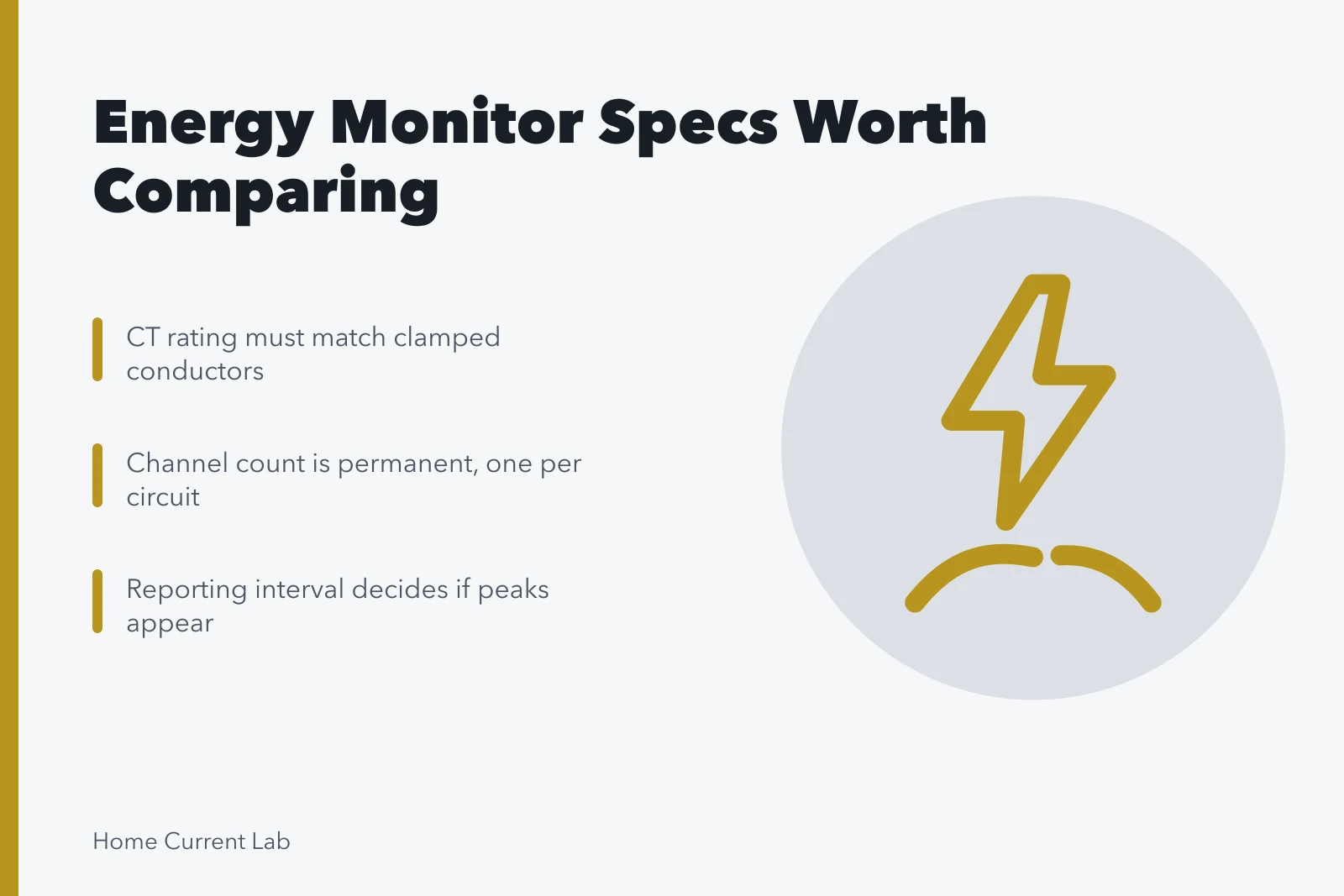
- Current transformer rating must match the conductors you are clamping.
- Channel count decides how much attribution you get, permanently.
- Accuracy class matters less than most buyers think, and export matters more.
- A monitor that cannot export raw data is not an instrument.
The specifications to record
Specification / Why it matters
- Current transformer rating
- Must suit the main and branch conductors in your panel
- Channel count
- Each channel is one circuit; adding more later means reopening the panel
- Sampling rate
- Determines whether short events are captured at all
- Reporting interval
- How often data is written, which is not the same as sampling
- Accuracy class
- Stated tolerance, usually adequate across the field
- Voltage sensing
- Whether it measures voltage or assumes a nominal value
- Local storage
- What happens to data during an internet outage
- Export format
- Raw values in an open format, or nothing
- Panel fit
- Physical space inside the enclosure for the hardware
The channel count row is the one people regret. Adding channels later means an electrician reopening a live panel, so decide up front which circuits you actually want attributed and add a margin.
Specs to record before buying
- Current transformer rating suits conductors
- Channel countone per circuit
- Sampling rate captures short events
- Reporting interval differs from sampling
- Accuracy classstated tolerance
- Voltage sensing vs assumed nominal
- Local storage and export format
Sampling rate versus reporting interval
These are confused constantly. Sampling rate is how often the hardware measures. Reporting interval is how often it writes a value you can see. A device sampling quickly but reporting once a minute will show you a smooth average and hide the short peaks that sampling captured.
Sampling rate vs reporting interval
Sampling rate
- What it is
- How often hardware measures
- What it hides
- Nothing
- Fast device, slow write
- Captures peaks
- Decides seeing compressor start
- No
- Matters for heat pump sizing
- Indirectly
Reporting interval
- What it is
- How often a value is written
- What it hides
- Short peaks
- Fast device, slow write
- Shows smooth average
- Decides seeing compressor start
- Yes
- Matters for heat pump sizing
- Directly
If you want to catch a compressor start or a brief resistance heat engagement, the reporting interval is the number that decides whether you see it. A short reporting interval matters most when a heat pump quote hinges on design temperature capacity and backup heat lockout.
Where the useful detail actually is
Monitoring earns its cost on the loads nobody thinks about; always-on and miscellaneous consumption grows quietly as households add equipment, and it stays invisible without circuit-level detail.
EIA projects that electricity use for commercial computing could surpass space cooling and ventilation. That shift appears at commercial scale; the residential version is slow accumulation of devices that never fully turn off.
For comparing your own totals against the industry's units and conventions, EIA's Electric Power Monthly is the standard reference for how U.S. electricity generation, sales and prices are reported. Getting your units straight makes a monitor's output comparable with a utility bill instead of merely interesting.
Specifications that do not decide much
- App screenshots.Every vendor's dashboard looks capable in a marketing image.
- Number of appliances the algorithm claims to detect.A count of categories, not a measure of accuracy.
- Cloud storage duration.Irrelevant if you can export; critical if you cannot, which is the real problem.
- Voice assistant support.Genuinely fun, not a selection criterion.
Before shortlisting, check the panel
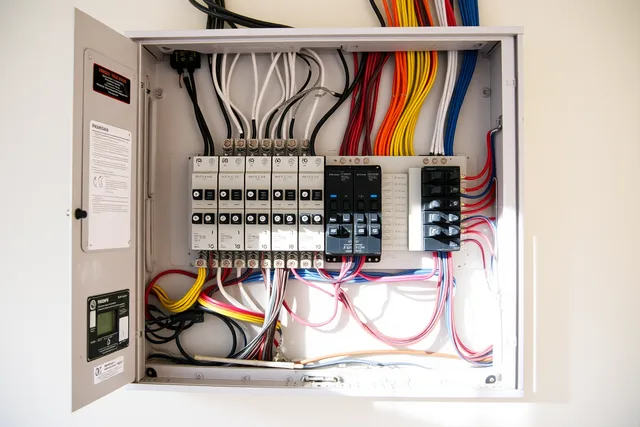
Physical fit rules out candidates faster than anything else. Panels vary, current transformers need room around the conductors, and the monitor body needs somewhere to sit. Send a photograph of the open panel to an electrician before ordering, and ask whether the hardware will fit and whether the conductors match the transformer rating.
For the general method of reading a specification sheet, see our guide to comparing specs; the levels of monitoring themselves are covered in what a monitor can tell you.